Becoming a Doctor
The Preventative Power of First Aid
The morning sounds of the village awakened me as usual. The staccato high-pitched chorus of guinea hens outside our front door, the bleating of sheep as they passed by on their morning rounds, the sputtering of the old Billy goat chasing a doe running and crying in protest, the sweep, sweep of Adama’s wives cleaning the courtyard, all punctuated by the distant village heartbeat of grain being pounded in wooden mortars.
To this music I made my way to the rear door to visit the W.C. and start my day. When I opened the door there were thirty villagers lined up waiting! Thirty! Youth, children, women of all ages, a few men – I closed the door briefly, was I still sleeping, then opened it again – why were they all lined up waiting at our back door?
I greeted them, and then asked them why they were there. They had come to be treated for a variety of injuries and ills. I reminded them that a few nurses came to the village on tour every week or so, and that they should see them when they were here. They replied that their medicine was not good, and that my medicine was good. I protested but they were not moved.
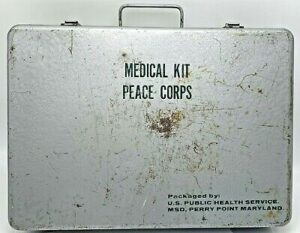 I got my Peace Corps first aid kit, put on some water to boil, and started to clean and dress all manner of wounds. Several had oozing infections wrapped in a scrap of cloth, pus encrusted and dirty, attracting flies. A man with leprosy had burned himself on his arm. Another wanted me to pull his painful tooth. A mother revealed an infection on her infant’s penis.
I had become the de facto village doctor since I took care of a serious injury on our building site resulting from an accident. Medical care was not any part of our project or training. The Ministry of Housing and Urbanism assigned us to work with the villagers to build housing that they could rent to functionaries who moved to the new souspréfecture of Sirasso. The heads of each extended family were formed into a cooperative to build, own and then rent the houses.
Each family elder sent a worker to provide the workforce to assist the carpenter, mason, block maker, and their apprentices. The families provided the manual labor. We were surprised the first day of work to meet the “volunteers” who were to help build thirty houses. Two little girls in tears, who were escorted by their fathers, a half dozen pre-teen boys, several young adults with minor disabilities, a few able bodied young men – in short a crew of workers who would not be overly missed from the families’ daily work in the fields.
We stored all water for making concrete and blocks in a cistern on our work site that we had to fill up as work progressed. The Souspréfet’s chauffer would drive his dump truck to the nearby swamp with our workers aboard, and they would fill a 500-gallon water tank trailer with a bucket brigade. When the tank was full we then brought it back to empty in the cistern. This required the trailer to be disconnected from the truck in order to be emptied.
The accident that was to add “doctoring” to our job description occurred when the strongest of our workers was reattaching the trailer to the trailer hitch. It was one of those slow motion moments, the imprint of being helpless to prevent an injury, while you watch it happen. The greasy trailer hitch fell on Nanilogo’s hand, pinching it between trailer and truck, tearing open the palm of his hand.
There was no option but to rush him to my house, grab the grey plastic first aid box, stop the bleeding and begin cleaning his wound with antibacterial wash. This was an injury that would have required stitches, but there was no doctor. After cleaning the wound of all dirt and grease I squeezed antibiotic ointment in it, and then put the skin together, binding it in place with sterile gauze. I told Nanilogo not to move his hand for three days. I visited him the next day, and he was sitting on a stool outside his hut with his hand in his lap.
After three days, he came to our house so I could change his bandage. To my relief the tear in the palm of his hand had fused together, and there was no sign of infection. He did not use his hand again until it had healed completely, and he regained its full use.
This injury could have been crippling if not fatal, as we had seen many minor cuts and scrapes that had become infected and turn into oozing ulcers lasting for months, getting larger and larger. After that moment of crisis, I started noticing that many of the children who were working with us had sores that were not healing. We started treating them morning and night with hot compresses, antiseptic and sterile gauze. The pharmacy in Korhogo was one more stop added to our trips for supplies. We had to stock up with the basics for first aid.
As kids started to hang out at our house, we taught them how to take care of minor cuts and scrapes. When people came to our house for first aid, if there were kids about, I would have them take care of the “patients.” Sometimes our house was the first stop for people returning from the fields. Feet cut while cultivating yams with a hoe, old injuries not yet healed. We always had time for first aid.
However, thirty people first thing in the morning was a moment of reckoning. This soon became a daily occurrence. I was not there to be a doctor, and I didn’t have the training. Traditional medicines provided valuable remedies for internal ailments, and I used them myself. Nevertheless, I realized the preventative power of immediate first aid. All that was needed were the supplies and a few simple skills. So from then on, I decided to teach the basics to each person who came, and get supplies on each trip to Korhogo. The supplies were not expensive, and the villagers gladly would give us some money to bring them what they needed to keep at home.
After some time, the villagers no longer needed us to take care of minor cuts and scrapes, and persistent infections were reduced. However, our reputation had spread and some people came from neighboring villages. It was not uncommon for me to meet strangers when stopping in outlying villages asking if I could diagnose and treat a variety of ailments. There were even surprising requests. The most memorable was the young man who came to me afraid that he was developing a goiter (a fairly common affliction for young women). He told me that he was developing a lump in his throat and wanted me to remove it. I felt the lump, and told him that it was normal for boys who were turning into men to have such a lump. I took his hand and pressed it to my throat so he could feel my Adam’s apple.
The Meaning of Time
The meaning of time is based largely on how you measure it. In the village of Sirasso, and throughout traditional rural communities they did not rely on a clock to count off the seconds, minutes, and hours. The concept of time that I came to learn was built into the environment and their language. The clock was the sun, and the name for “sun” was “tere” which also meant “day” and “noon.” Time was noted by the greetings, and by the terms for morning, noon, afternoon, and night. The rhythms of time were based on the rhythms and rituals of daily life, unambiguous markers in the day. (Read more >>)