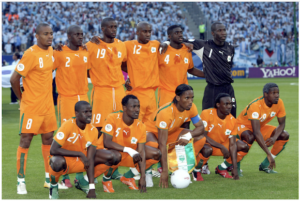
Les Eléphants 2006
Despite being shaken by a civil war, the entire country danced for two days following Ivory Coast’s World Cup qualification. A successful tournament might help the divided nation to reconcile. (2 June 2006 Spiegel)
When I was a Peace Corps volunteer in the Côte d’Ivoire (Ivory Coast) over 35 years ago it was very different from the torn country it is today. Since 1999, the country has been mired in coups, rebellions and ethnic conflicts and since September 2002 it has been cut in half by civil war and its economy is in shambles. In the post-colonial 60’s the concept of nationhood and civil government had not yet entered the consciousness of all Ivorians. Tribal affiliation, language and traditions were most important as well as the day-to-day concerns of life.
However, peace, prosperity, mobility and a culture of hospitality prevailed. The name of the one daily newspaper, “Fraternité Matin” (literally “The Brotherhood Morning”) was an apt slogan for the Côte d’Ivoire, and the father of Ivorian independence, president Félix Houphouët-Boigny, was viewed by all tribes as “the old man” a term of respect, authority and endearment. National politics was conducted starting from traditional village councils and worked its way up to the Senate. Boigny’s cabinet had representatives of all the ethnic groups.
Since the very survival of the Côte d’Ivoire was put at risk with the coup of 1999, it wasn’t until the “Eléphants,” the national soccer team (and all but extinct national symbol) had the possibility to qualify for the World Cup soccer this year, that a movement towards disarmament and reconciliation between the opposing forces in their civil war began. This was not a coincidence, but rather a reflection of the national psyche — echoing the goal of the national team, self-proclaimed ambassadors of peace. As reported by IRIN news.org:
The five key players in Cote d’Ivoire’s conflict have renewed their commitment to peace efforts after holding their first face-to-face talks at home since war broke out more than three years ago.While there were few concrete agreements, Tuesday’s four-hour meeting behind closed doors broke new ground and brought fresh hopes of a breakthrough in stumbling efforts to reunify the West African nation, divided between a rebel-held north and government south since 2002. (1 Mar 2006 IRIN)
I remember thinking in 1970 that soccer was the first sign of national identity to surface in post-colonial Côte d’Ivoire. Beside the fact that almost every village had a makeshift soccer field where barefoot boys would chase an improvised “ball” over gravelly red earth, I heard partisans “argue” the merits of the two most popular contenders for the Coupe de Côte d’Ivoire, ASEC and Africa Sport, much like our kids argue about the merits of teams vying for the World Series or Superbowl. This was a loyalty that transcended one’s ethnic identity.
When I look at the family names of the Eléphants (Drogba, Dindane, Touré, Akale, Zokora, Kalou, Kouassi, Koné, Keïta, Eboué…) I see the names of diverse tribal and geographical groups, the ones currently fighting each other. It truly is a national team, and (ironically) is coached by a Frenchman, Henri Michel. Michel has collected the best Ivorian players who play on teams all over Europe. The symbolism of all this is a huge unifier for Ivorians and has finally given them some hope.
Whether or not the Eléphants win or lose in the games of the World Cup. They have won a diplomatic victory by pushing the peace process forward in their country. With so much international attention focused on the Côte d’Ivoire because of their soccer team, and the vision of unity it presents for Ivorians, the leaders must pursue peace and reconciliation.
The world ought to take note of the symbolism of the Ivorian experience. It is really a tragedy when a peaceful country with such promise crashes into the chaos of hatred and divisiveness. This little country is a case study of a contagious political illness infecting much of the world. When there is seemingly no basis for reconciliation, the healing factor turns out to be celebration. Sport may be a metaphor for healthy and respectful competition; for teamwork and abiding to commonly accepted rules; for striving to excel and celebrating achievement. So-called “civilized” countries need to use the model of sportsmanship in conducting domestic and international relations. In a world torn by conflict, “soccer diplomacy” may be a valid passion.